
Description
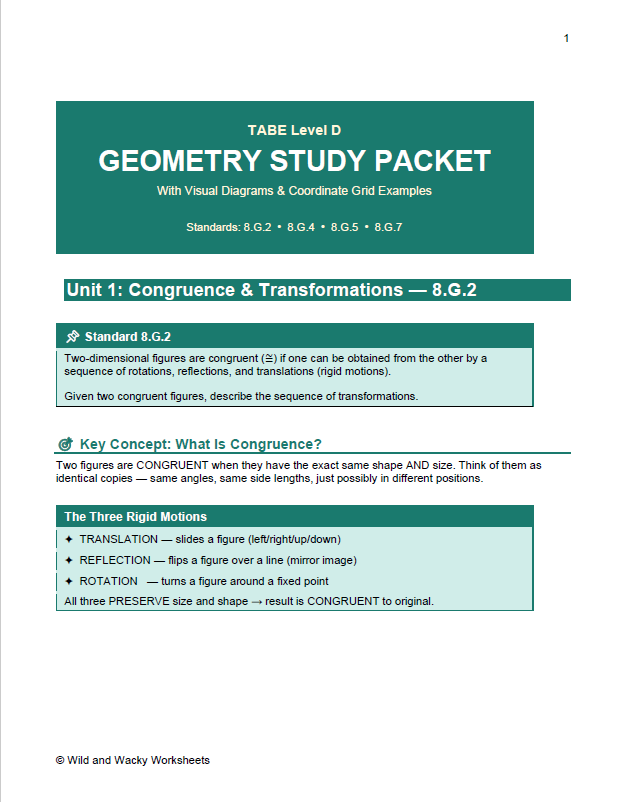
TABE Level D Geometry Study Packet
This packet covers all four high-priority geometry standards tested at Level D: transformations and congruence (8.G.2), similarity and dilations (8.G.4), angles and parallel lines (8.G.5), and the Pythagorean Theorem (8.G.7) — all in one cohesive, teacher-ready resource designed specifically for adult education classrooms.
Whether you teach ABE, GED prep, TABE prep, workforce development, correctional education, or community college transition programs, this packet gives your adult learners the structured instruction, visual support, and abundant practice they need to master geometry — and walk into test day with confidence.
WHAT’S INCLUDED — 4 COMPLETE UNITS:
Unit 1: Congruence and Transformations (8.G.2)
- Full lesson covering translations, reflections, rotations, and the concept of congruence
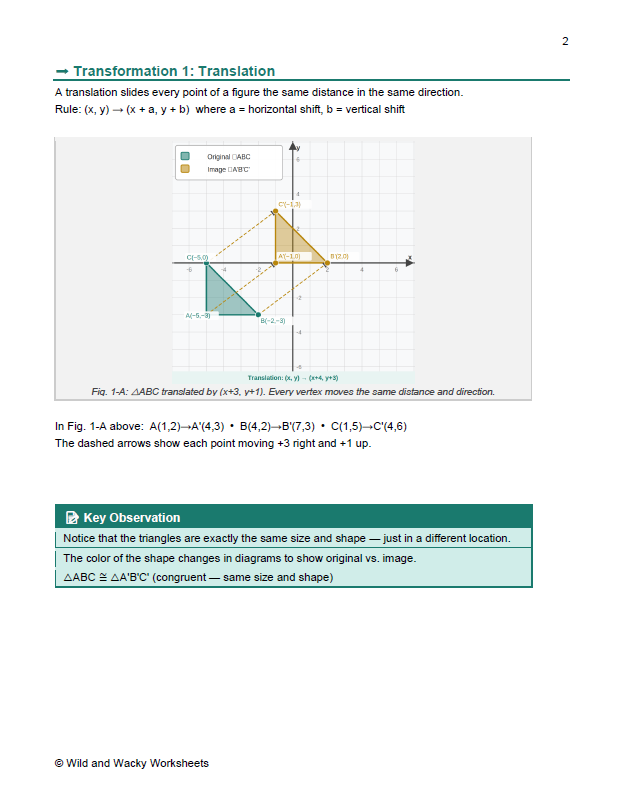
- Color-coded coordinate grid diagrams for each transformation type: translation, reflection over x-axis, reflection over y-axis, rotation 90° CCW, rotation 180°
- Transformation rules table for all common rotations and reflections
- Sequence of transformations lesson with step-by-step diagram (Fig. 1-F) showing a two-step transformation across three quadrants
- Introduction to dilations: side-by-side comparison diagram (Fig. 1-G) contrasting rigid motions (congruent results) with dilations (similar but not congruent) — with tick marks showing equal vs. doubled side lengths
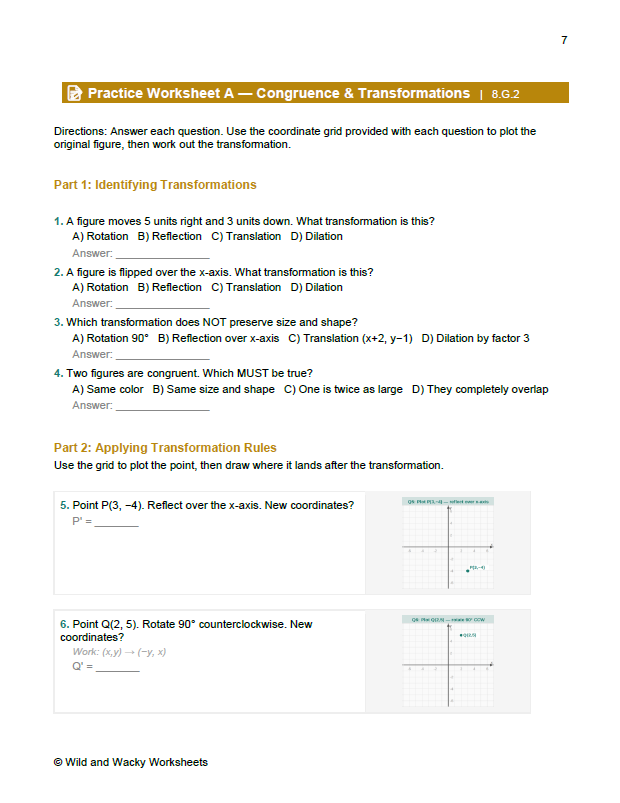
- Practice Worksheet A: 15 questions covering identification, coordinate rules, describing transformations, and multi-step sequences — every coordinate problem includes a pre-plotted grid showing the original figure
- Practice Worksheet B: 10 questions with coordinate grid practice, multi-step challenges, and conceptual explanation questions
Unit 2: Similarity and Dilations (8.G.4)
- Full lesson on similar figures, scale factor, and dilations
- Congruent vs. Similar comparison table
- Dilation diagrams: k=2 (enlargement) and k=½ (reduction), both with dilation rays from the origin
- AA Similarity diagram with matching angle arcs color-coded across both triangles
- Scale factor table (enlargement, reduction, k=1)
- Properties of similar figures: angle preservation, proportional sides, perimeter and area scaling
- Worked example: finding missing sides in similar triangles
- Practice Worksheet: 15 questions covering dilation coordinates, missing side lengths, scale factor, properties, similarity sequences, and a real-world map scale problem — coordinate problems include pre-plotted grids
Unit 3: Angles — Triangles, Parallel Lines, and AA Similarity (8.G.5)
- Full lesson covering all three components of 8.G.5
- Triangle Angle Sum Theorem diagram with mathematically correct arc markers at each vertex
- Exterior Angle Theorem diagram with extension line, correct arc placement, and formula callout
- Parallel lines cut by a transversal diagram — numbers 1–8 placed using computed bisector angles so each label sits precisely inside the correct angle wedge; color-coded by angle relationship (red = corresponding, purple = alternate interior)
- Angle pairs reference table: corresponding, alternate interior, alternate exterior, co-interior, vertical, linear pair
- AA Similarity criterion diagram with matching color-coded angle arcs across two proportionally different triangles
- Practice Worksheet: 16 questions across four parts covering triangle angle sum, exterior angle theorem (including algebraic problems), parallel lines and transversals, and AA similarity
Unit 4: Pythagorean Theorem (8.G.7)
- Full lesson: the theorem, all three problem types (find hypotenuse, find leg a, find leg b), non-perfect square examples, Pythagorean triples table, real-world applications, distance between two points, and 3D problems (space diagonal)
- Right triangle diagram with formula callout and labeled legs/hypotenuse
- Ladder problem illustration with solution work shown
- Pythagorean triples reference table (3-4-5, 5-12-13, 8-15-17, 7-24-25) with multiples
- Practice Worksheet A: 15 questions — missing sides, converse (is it a right triangle?), distance between two points on a coordinate grid (with pre-plotted grids), and Pythagorean triples
- Practice Worksheet B: 12 real-world application problems — ladder, baseball diamond, boat navigation, TV diagonal, ramp, rectangular park, wire and pole, coordinate distance, 3D room diagonal, kite height, converse verification, and a multi-step challenge problem
🗝 COMPLETE ANSWER KEY WITH STEP-BY-STEP EXPLANATIONS:
Every single question includes a full, detailed explanation — not just the answer. Explanations show the rule applied, the arithmetic work, and the reasoning behind the answer. This makes the answer key useful for:
- Self-checking by students
- Instructor review and grading
- Re-teaching moments when a student gets something wrong
- Substitute teachers with no geometry background
AT A GLANCE:
- ✅ 4 complete units with full lessons
- ✅ 14 original coordinate grid diagrams and geometry figures
- ✅ 60+ practice problems across 6 worksheets
- ✅ Pre-plotted coordinate grids for every applicable practice problem
- ✅ Complete answer key with step-by-step explanations for every question
- ✅ Standards-aligned: 8.G.2, 8.G.4, 8.G.5, 8.G.7 (CCRS / TABE 11 & 12 Level D)
- ✅ Professional teal and gold branding
- ✅ Suitable for in-class instruction, independent study, tutoring, and test prep centers
PERFECT FOR:
- TABE 11/12 Level D math preparation
- Adult Basic Education (ABE) geometry instruction
- GED math prep — geometry and measurement
- Workforce development and job training programs
- Correctional education and re-entry programs
- Community college developmental math
- Adult high school diploma programs
- ESL/ESOL learners in higher literacy levels
- Distance learning and self-paced adult education
- One-on-one tutoring for TABE or GED geometry
- 8.G.2 — Congruence through rigid motions (rotations, reflections, translations); describing transformation sequences
- 8.G.4 — Similarity through rigid motions and dilations; describing similarity sequences; scale factor
- 8.G.5 — Triangle angle sum; exterior angle theorem; parallel lines and transversals; angle-angle similarity criterion
- 8.G.7 — Pythagorean Theorem in two and three dimensions; distance between points; real-world applications
For a fun way to study for the TABE, check out the TABE Escape Room.

Reviews
There are no reviews yet.