
Description
Adult Education Teacher Training Manual | GED | ABE | TABE | Workforce Development
Are you onboarding a new adult education teacher, tutoring aide, or program volunteer? Do you lead professional development for GED, ABE, TABE, or workforce literacy instructors? This comprehensive, research-based training manual gives new adult educators everything they need to walk into the classroom with confidence — from understanding how adults learn to trauma-informed teaching, lesson planning, and professional growth.
Built from 30+ years of adult education classroom experience and grounded in the latest research from NCSALL, COABE, the National Reading Panel, and cognitive science, this is the professional development resource you wish you’d had on Day One.
WHAT’S INCLUDED
✅ 8 fully developed chapters with rich instructional content
✅ 8 reproducible student worksheets (one per chapter)
✅ Complete answer key with model responses and coaching notes for every worksheet
✅ Research callout boxes throughout with citations from Knowles, Bloom, Tuckman, Edmondson, and more
✅ 10+ ready-to-use classroom tools and graphic organizers (KWL chart, Frayer Model, Gradual Release template, Bloom’s taxonomy table, VAK self-survey, and more)
✅ Scenario-based activities for real-world practice
✅ Professional growth planning section with SMART goal template
CHAPTER-BY-CHAPTER OVERVIEW
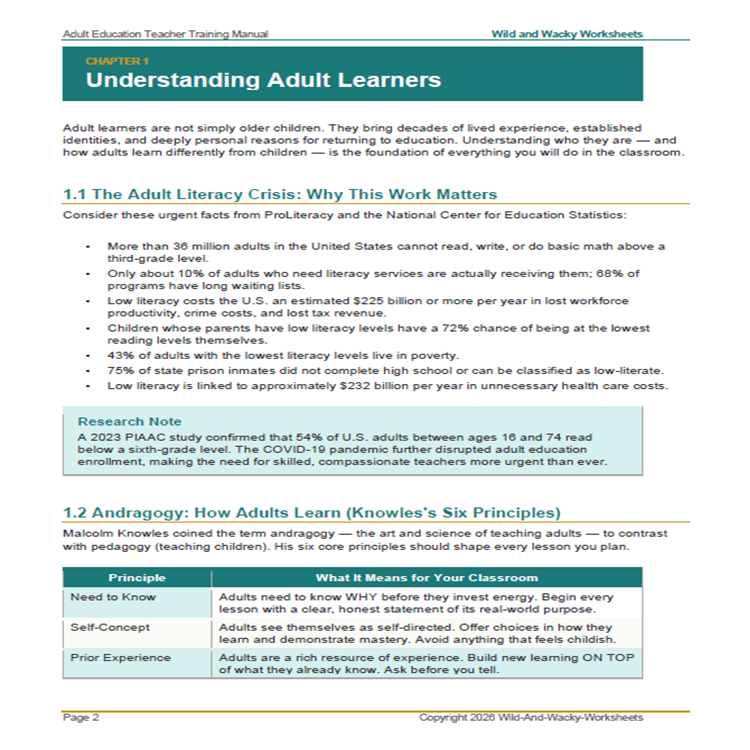
Chapter 1: Understanding Adult Learners Covers the adult literacy crisis (statistics from ProLiteracy and PIAAC), Malcolm Knowles’s six principles of andragogy in a classroom-ready reference table, and the emotional landscape of returning adult learners — including math anxiety research and neuroplasticity. Teachers learn WHY adult education is both urgent and different from K–12 instruction.
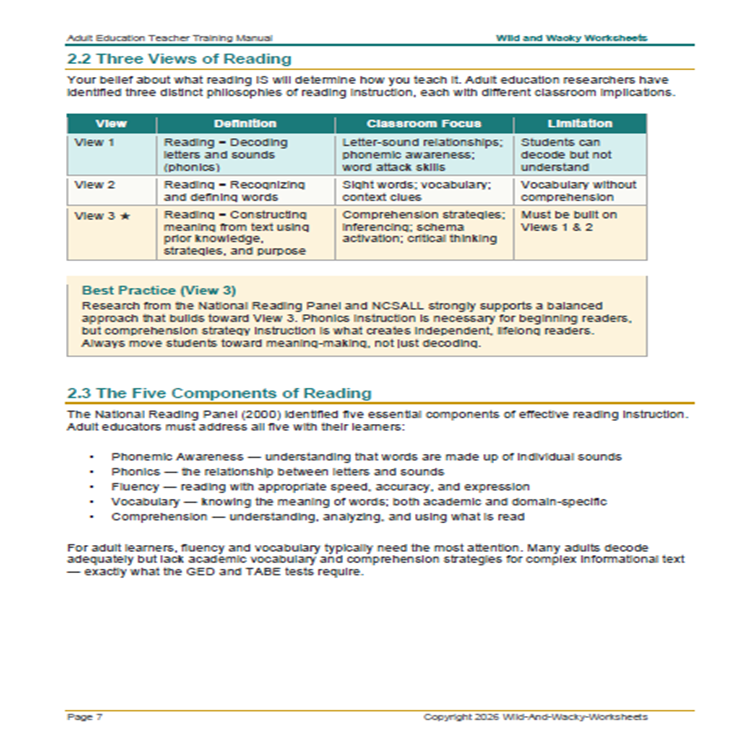
Chapter 2: Foundations of Literacy Explores the daily uses of literacy (reading, writing, listening, speaking as an integrated whole), three views of reading philosophy and how a teacher’s beliefs shape their instruction, and the National Reading Panel’s five essential components of reading — with specific guidance for adult literacy programs.
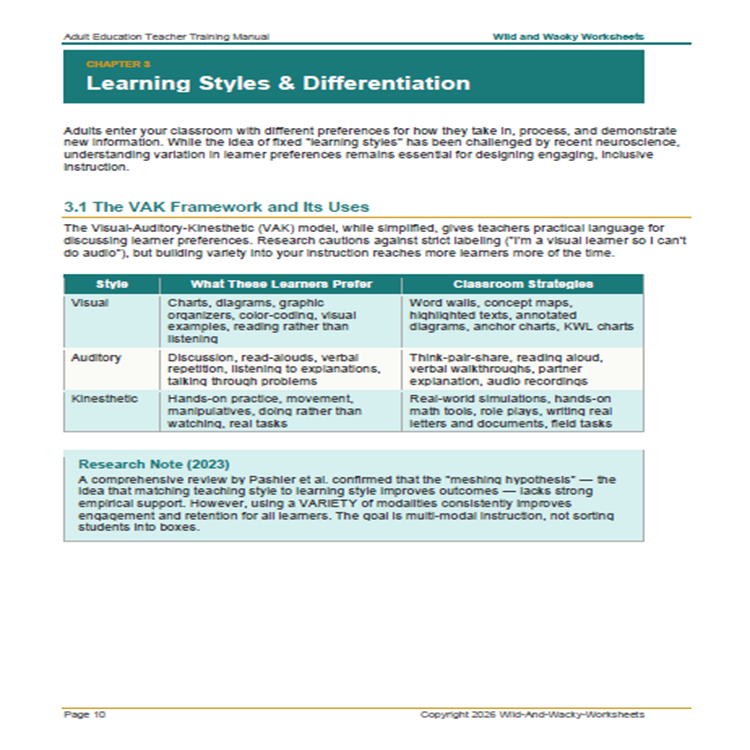
Chapter 3: Learning Styles & Differentiation Covers the VAK (Visual-Auditory-Kinesthetic) framework with practical classroom strategies for each, a research-based caution against rigid “learning style” labeling, and a detailed Learning Disabilities screening table covering reading, math, and organizational indicators. Ideal for programs serving diverse or undiagnosed populations.
Chapter 4: Effective Instructional Strategies Six high-leverage, evidence-based strategies: explicit instruction with the I Do / We Do / You Do framework, metacognitive strategy instruction, vocabulary pre-teaching, contextualized learning, collaborative structures, and formative checks for understanding. Includes a full, reproducible Frayer Model graphic organizer.
Chapter 5: Lesson Planning & Assessment Introduces backward design (Wiggins & McTighe), all three types of assessment (diagnostic, formative, summative) with real adult education examples, and a complete Bloom’s Taxonomy table with action verbs and adult education objectives at every level. Teachers practice writing measurable objectives and designing exit tickets.
Chapter 6: Building the Learning Community Expands Tuckman’s Forming–Storming–Norming–Performing model with specific teacher responses for each stage. Includes Amy Edmondson’s psychological safety research, wait-time strategy, co-creating classroom norms, and a first-day activity teachers can use immediately.
Chapter 7: Special Populations & Equity Strategies for ELL students, trauma-informed teaching practices with a behavior-to-response table, and disability accommodations aligned with Section 504. Three realistic case-study scenarios with guided reflection questions bring the content to life.
Chapter 8: Professional Practices & Self-Care COABE professional standards overview, Donald Schon’s reflective practice framework, three post-lesson reflection questions, and research-backed guidance on preventing teacher burnout. Closes with a professional growth planning worksheet and SMART goal template.
WORKSHEETS INCLUDED
- Worksheet 1-A: Who Are Your Adult Learners? (includes KWL chart)
- Worksheet 2-A: Daily Uses of Literacy — Teacher Reflection
- Worksheet 3-A: My Learning Preferences — VAK Self-Survey (30 questions, scored)
- Worksheet 4-A: Gradual Release Lesson Plan Template (I Do / We Do / You Do)
- Worksheet 5-A: Assessment Design Practice (rewrite fuzzy objectives + design exit ticket)
- Worksheet 6-A: First-Day Community-Building Activity Planner
- Worksheet 7-A: Equity Scenarios — What Would You Do? (3 case studies)
- Worksheet 8-A: Professional Growth Planning + SMART Goals
ANSWER KEY
The included answer key goes far beyond “correct answers.” Each response includes instructional coaching notes explaining WHY the answer matters and what distinguishes a strong response from a surface one — making this a true facilitator’s guide, not just a scoring sheet.
WHO NEEDS THIS?
- Adult education programs onboarding new teachers or volunteer tutors
- GED, ABE, TABE, and workforce literacy programs
- Correctional education programs training teacher aides
- Community college adult education departments
- Literacy councils and nonprofit adult literacy organizations
- Experienced teachers mentoring or training newer colleagues
- Teacher educators running pre-service or in-service professional development
STANDARDS ALIGNMENT
Content aligns with:
- COABE Standards for Adult Education (2023)
- College and Career Readiness Standards (CCRS) for Adult Education
- ProLiteracy America tutor training competencies
- TESOL Adult Education Professional Teaching Standards
Give your trainees an insight into classroom management with the following resource: Brain Breaks for the Adult Education Classroom.

Reviews
There are no reviews yet.