Master the GED RLA: How to Teach Summary Writing (and Why It’s a Game Changer)
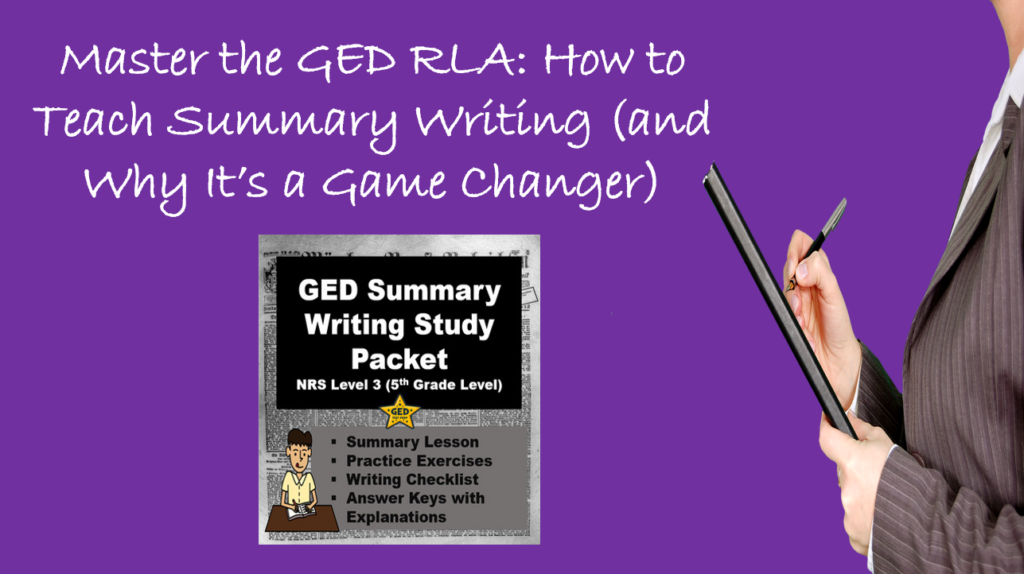
For many adult learners, the “Summary” feels like a trap. They often ask, “How can I tell you what the whole story is about without telling you everything?” In the GED Reasoning Through Language Arts (RLA) module, summary writing isn’t just a “nice-to-have” skill—it is a core component of reading comprehension. To help your students bridge the gap between reading a text and truly understanding it, we’ve developed a specialized resource: the GED Summary Writing Study Packet.
Why Summary Writing is the “Secret Weapon” of the GED
Summary writing forces the brain to move from passive reading to active processing. When a student summarizes, they are doing three high-level tasks simultaneously:
- Filtering: Deciding what is a “need-to-know” versus a “nice-to-know.”
- Paraphrasing: Translating complex academic language into their own voice.
- Synthesizing: Connecting the beginning, middle, and end into a cohesive thought.
If a student can summarize a passage, they can answer almost any “Main Idea,” “Inference,” or “Author’s Purpose” question the GED throws at them.
Breaking Down the Walls: The 5-Step Summary Method
Most adult education students struggle with summaries because they try to write the summary while they are reading. This leads to “Information Overload.”
The GED Summary Writing Study Packet uses a Scaffolded 5-Step Method designed to lower anxiety and increase accuracy. Instead of jumping straight into a full essay, students start small:
- Finding Main Ideas: Distinguishing the “big picture” from the supporting details.
- The One-Sentence Challenge: Learning to condense a paragraph into a single, punchy sentence.
- Fixing “Bad” Summaries: This is often the “lightbulb” moment. By analyzing common mistakes, students learn what not to do before they apply it to their own writing.
High-Interest Topics for Adult Learners
Let’s be honest: practicing with dry, academic texts is the fastest way to lose a student’s interest. This study packet utilizes NRS Level 3 (5th Grade Level) texts that focus on engaging, real-world topics. Your students will practice their skills while reading about:
- History & Heroes: Harriet Tubman and the American Revolution.
- Science & Nature: The water cycle, honeybees, and dolphins.
- Global Cultures: Ancient Egypt and environmental recycling.
By using high-interest content, students stay focused on the skill of writing rather than getting bogged down by overly technical vocabulary.
What’s Inside the 18-Page Study Packet?
Designed by Wild and Wacky Worksheets, a creator with 30 years of teaching experience, this packet is a “print-and-go” solution for busy educators.
| Feature | Benefit |
| “DO” and “DON’T” Rules | Provides clear boundaries for students who tend to over-write. |
| 7 Diverse Exercises | Covers everything from one-sentence summaries to multi-paragraph challenges. |
| Self-Assessment Checklist | Empowers students to edit their own work before turning it in. |
| Full Answer Key | Includes explanations, making it perfect for independent study or sub plans. |
Final Thoughts for GED Instructors
Teaching summary writing doesn’t have to be a struggle. By breaking the process down into manageable steps and providing plenty of scaffolded practice, you can help your students build the confidence they need to ace the RLA section.
Ready to save hours of prep time? Download the GED Summary Writing Study Packet here and give your students the tools they need to succeed!