New! The Ultimate TABE 13/14 Test Prep Escape Room
Preparing adult learners for the TABE 13/14 (Test of Adult Basic Education) can often feel like an uphill battle. Traditional worksheets and repetitive drills frequently lead to disengagement, test anxiety, and stagnant progress scores. Adult Basic Education (ABE) and GED prep instructors are constantly searching for dynamic, rigorous resources that respect the maturity of adult learners while targeting precise educational standards.
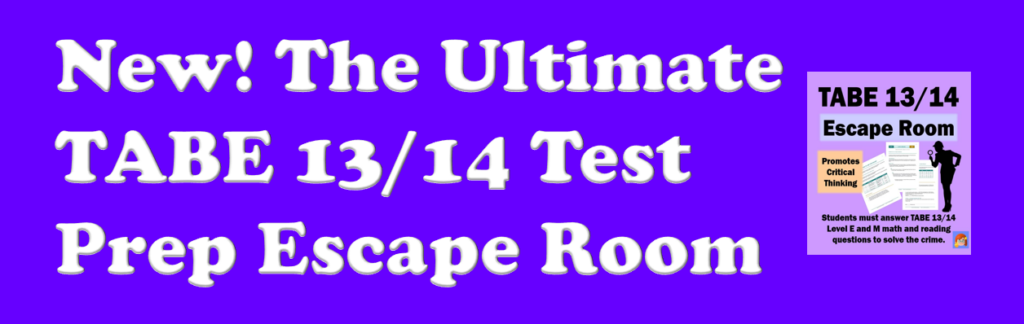
If you are looking to inject critical thinking, genuine engagement, and multi-subject mastery into your classroom, look no further than the TABE 13/14 Escape Room: Levels E and M Reading and Math by Wild and Wacky Worksheets.
This comprehensive resource flips the script on traditional test prep, transforming standard review days into a high-stakes, immersive criminal investigation. Below, we break down why this exact resource is a must-have tool for boosting TABE scores and how to implement it effectively in your adult education program.
The Challenge of TABE 13/14 Prep in Adult Education
The TABE 13/14 is meticulously aligned with the College and Career Readiness Standards (CCRS). It doesn’t just test rote memorization; it demands that students analyze data, synthesize text, evaluate conflicting claims, and justify their reasoning.
For instructors, this poses unique challenges:
- The Mixed-Level Classroom: It is incredibly common to have students working at TABE Level E (Easy/Beginning) and Level M (Medium/Intermediate) sitting in the exact same room. Creating separate lesson plans for each group is time-consuming and can make lower-level students feel singled out.
- Time Constraints: Many workforce development and adult literacy programs have limited instructional hours. Covering reading comprehension, mathematical operations, and written expression sequentially can take weeks.
- Passive Disengagement: Adult learners often carry negative past experiences with schooling. Handing them a generic test-prep packet can trigger anxiety or boredom.
The TABE 13/14 Escape Room solves all three obstacles simultaneously.
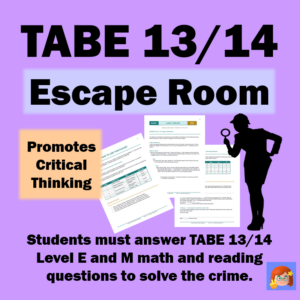
Inside the Mystery: “The Case of the Stolen Golden Compass”
Unlike elementary school activities that simply slap a “detective hat” clip art onto a standard worksheet, this resource features a fully realized, authentic mystery narrative.
The Plot
The Golden Compass of Truth has been stolen from the Metro City Museum. Five suspects were caught near the museum on the night of the crime. To crack the case, your adult learners must act as lead investigators. They will move through 5 distinct Evidence Rooms, analyzing real case files, evaluating data, calculating mathematical constraints, and weighing conflicting suspect testimonies.
A Breakdown of the Evidence Rooms
The activity spans 47 total questions intentionally designed to scale in difficulty and bridge multiple academic disciplines:
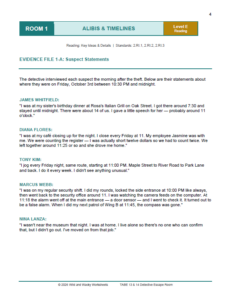
- Rooms 1 & 2 (TABE Level E Focus): These foundational rooms build confidence. They focus on foundational reading standards, basic reading comprehension, and essential mathematical applications like addition, subtraction, and simple word problems.
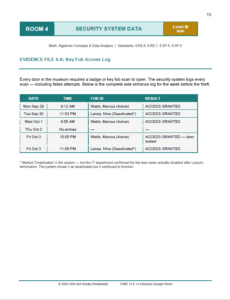
- Rooms 3 & 4 (TABE Level M Focus): The complexity heightens. Students dive into multi-step math problems, data interpretation, and identifying text structures or main ideas within the case files.
- Room 5 (Combined Levels E & M): The ultimate culmination. Students must synthesize everything they have learned across both levels to eliminate the final false suspects and isolate the true culprit.
Why This Resource is a Game-Changer for Teachers
1. Seamless, Natural Differentiation
Because the packet transitions smoothly from Level E tasks to Level M tasks, you can hand the exact same resource to your entire class. Advanced students will naturally push through to the later rooms, while developing students can solidify their foundational skills in the early rooms. No one is segregated, and everyone works on the same cohesive mystery.
2. True Reading and Math Integration
Finding a resource that authentically tests both math and reading without feeling forced is rare. In this escape room, a student might read a suspect’s alibi (Reading Standards) and then check the suspect’s timeline against museum floor plans or travel distances using calculations (Math Standards). It perfectly mirrors the real-world problem-solving required in modern careers.
3. Built-In Writing and Portfolio Evidence
The included Detective’s Case File features 15 open-response prompts. Students cannot simply guess multiple-choice options; they must write down their logical reasoning after finishing every room and defend their final verdict in writing. This makes the packet an incredible tool for:
- Student portfolios
- Progress monitoring documentation
- Informing Measurable Skill Gains (MSGs)
4. No External Props Required (Low Prep!)
Many educational escape rooms require physical locks, boxes, or complex digital setups. This is a highly efficient print-and-go PDF resource. Everything the student needs is contained within the 27 pages, making it an excellent option for substitute lesson plans, standalone workshops, or designated review days.
Targeted Educational Standards
This activity isn’t just fun—it is highly strategic. Every single room is mapped directly to College and Career Readiness and Common Core standards tested on the TABE 13/14.
Reading Standards Addressed:
- Key Ideas and Details: 2.RI.1, 2.RI.2, 2.RI.3
- Craft and Structure: 4.RI.5, 5.RI.6
- Integration of Knowledge and Ideas: 5.RI.8, 5.RI.9, 5.RL.6
Math Standards Addressed:
- Operations and Algebraic Thinking: 3.OA.3, 4.OA.3
- Number and Operations in Base Ten: 3.NBT.2 (Fluently adding/subtracting within 1000)
- Measurement and Data: 4.MD.3
- Expressions and Equations: 6.EE.6, 6.EE.7
- Statistics and Probability: 6.SP.4, 6.SP.5
How to Implement the TABE Escape Room in Your Classroom
With a total teaching duration of 60 to 90 minutes, this resource easily fits into a standard instructional block. Here are a few ways to maximize its impact:
- Collaborative Pairs: Pair a lower-level student with a higher-level student. This fosters peer-to-peer mentoring, forcing students to verbally articulate their mathematical operations and textual evidence to one another.
- Learning Stations: Transform your classroom into literal “Evidence Rooms.” Place copies of Room 1 at Station 1, Room 2 at Station 2, and have students move physically around the room as they crack each segment of the case.
- Socratic Debates: The evidence in the early rooms is intentionally ambiguous. Use the comprehensive Teacher Answer Key to orchestrate classroom disagreements. If half the class thinks Suspect A is guilty based on Room 2, challenge them to defend their stance using the evidence before unlocking Room 3.
Final Verdict: Is It Worth It?
At a budget-friendly price point, the TABE 13/14 Escape Room provides an incredible return on investment. It saves you hours of lesson planning, keeps adult learners genuinely entertained, and directly moves the needle on the precise math, reading, and writing skills tested on the TABE.
Give your adult education students the rigorous, engaging review session they deserve. Purchase from Wild and Wacky Worksheets or on this website by going to the shop tab at the top of the page!