Hook Your Students with True Crime: The Ultimate GED Prep Secret

Let’s be honest: traditional GED prep materials can sometimes feel a bit… dry. When you’re working with adult learners who have busy lives and competing priorities, “standard” reading passages about historical figures or scientific theories don’t always grab their attention.
If you are looking for a way to transform your classroom engagement while building high-level critical thinking, it’s time to lean into a genre your students likely already love: True Crime.
The GED Crime Lovers Bundle is a comprehensive collection of eight high-interest resources designed to turn reluctant readers into “classroom detectives.” Here is why this bundle is a game-changer for GED instructors and students alike.
Why True Crime Works for GED Prep
The GED is no longer a test of rote memorization; it is a test of evidence-based reasoning. Students must be able to:
- Identify the difference between objective facts and subjective opinions.
- Synthesize information from multiple sources.
- Identify bias and author’s purpose.
- Make logical inferences based on textual evidence.
By using “Wacky” and intriguing real-world scenarios—from forensic investigations to the psychology of cults—students perform these complex cognitive tasks without even realizing they are “studying.”
What’s Inside the Bundle?
With 429 pages and over 700 questions, this bundle covers the essential skills needed for the RLA, Science, and Social Studies sections of the GED.

1. The Investigative Series (Forensic Files)
This three-volume set functions like a crime lab.
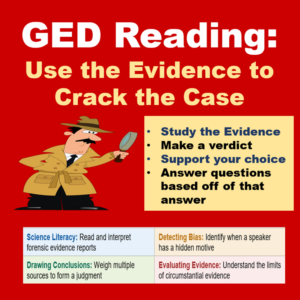
Volume 1: The Art of the Witness: Focuses on Evaluating Conflicting Evidence. Students don’t just read; they compare police reports against witness statements to identify inconsistencies—a direct mirror of the “Synthesis” tasks on the GED Social Studies test.
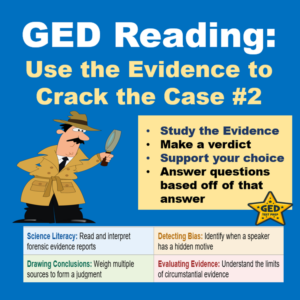
Volume 2: The Science of the Crime: Moves beyond basic reading into Technical Literacy. It introduces students to the scientific method through toxicology and DNA basics, helping them practice interpreting data tables and scientific diagrams.
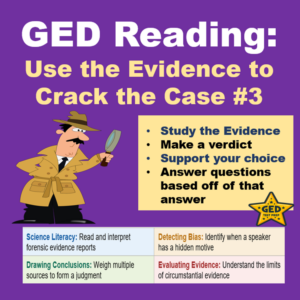
Volume 3: The Visual Evidence: Centers on Information Integration. By analyzing “crime scene” descriptions alongside visual data, students learn to translate written text into mental (and physical) maps, improving their spatial reasoning and attention to detail.
2. Psychology and Persuasion
The GED RLA Extended Response requires students to analyze how an author builds an argument. The Cults & Charismatic Leaders resource is a perfect tool for this, as it forces students to deconstruct persuasive language and identify manipulative tactics.
The Power of Rhetoric: This section isn’t just about cults; it’s about Deconstructing Arguments. Students analyze “manifestos” and recruitment speeches to find logical fallacies and emotional appeals.
The Extended Response Edge: Because the GED requires students to write an essay comparing two arguments, this resource provides the perfect “practice arena.” Students learn to identify which “charismatic leader” has the stronger evidentiary support, making the transition to the RLA Extended Response feel like a natural extension of the lesson.
3. Building Stamina and Fluency
For students who struggle with long-form texts, the Dumb Crooks Literacy Set provides short, hilarious stories that focus on main ideas and chronological sequencing. Meanwhile, the Unsolved Mysteries section encourages students to evaluate competing theories, providing a natural bridge from basic literacy to high-school level analysis.
Reading Between the Lines: Stalkers & Obsession
The ability to Make Inferences is the hallmark of a successful GED candidate. This module focuses on behavioral reports and 15 different passages that require students to draw conclusions that aren’t explicitly stated in the text.
Dumb Crooks Literacy Set: These act as “High-Interest, Low-Level” (Hi-Lo) entry points. They are designed to build Reading Confidence for students who are intimidated by long blocks of text. The humor keeps the affective filter low, allowing them to focus on foundational skills like identifying the Main Idea and Supporting Details.
Unsolved Mysteries & Critical Thinking: This module introduces Open-Ended Analysis. Unlike a standard test question with one “right” answer, these mysteries require students to argue for the most probable theory based on the limited facts provided. This forces them to practice “Citing Textual Evidence” repeatedly to defend their theories.
- What Students Learn: Students act as behavioral analysts, using subtle clues in the text to determine motivation, predict future outcomes, and summarize complex relationships between “characters” in real-life scenarios.
- The Classroom Connection: Because these stories are high-stakes and high-interest, students are more willing to engage with the “denser” behavioral analysis questions that often appear in the Social Studies and Reading sections.
- Resource Link: GED Reading Practice: True Stalker Stories
If you are looking for the “hook” that finally gets your students excited about reading long-form text, this is it. The GED Reading Practice: True Crime resource is the anchor of the Crime Lovers collection.
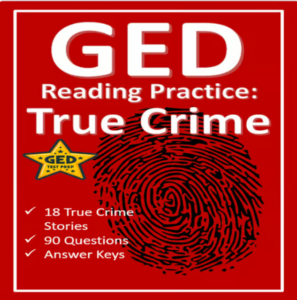
It transitions students from basic comprehension to the deep analytical work required to pass the GED. Instead of practicing on generic academic essays, students tackle 18 gripping, true-life stories that naturally encourage high-level engagement.
- What’s Inside: A massive 76-page packet featuring 90 comprehension and analysis questions tailored to the rigors of the GED RLA and Social Studies exams.
- Key Skills Targeted: * Main Idea & Supporting Details: Identifying the “who, what, when, where, and why” of complex criminal cases.
- Vocabulary in Context: Learning high-level legal and investigative terminology within the flow of a narrative.
- Chronological Reasoning: Reconstructing timelines of events—a critical skill for Social Studies literacy.
- The Classroom Connection: This resource is perfect for Independent Work Packets or guided group reading. Because the stories are so compelling, students are more likely to build the “reading stamina” necessary for the actual test without feeling the fatigue of a standard prep book.
Standards Alignment You Can Trust
Every resource in the GED Crime Lovers Bundle is aligned with College and Career Readiness Standards (CCRS). Whether you are teaching Level D or E reading, these passages require students to cite strong textual evidence and support their claims—the exact skills they need to see “PASS” on their results report.
The GED Crime Lovers Bundle is specifically designed to align with the College and Career Readiness Standards (CCRS) for Adult Education, primarily focusing on Levels D and E.
By engaging with these true crime scenarios, students master the following core standards across RLA, Science, and Social Studies:
Reading & Language Arts (RLA)
- Citing Textual Evidence (CCR Anchor 1): Students are required to cite strong and thorough textual evidence to support their analysis of what the text says explicitly as well as inferences drawn from the text (e.g., in the Stalkers & Obsession and Unsolved Mysteries modules).
- Delineating and Evaluating Arguments (CCR Anchor 8): In the Psychology and Persuasion section, students must evaluate the argument and specific claims in a text, assessing whether the reasoning is valid and the evidence is relevant and sufficient.
- Determining Central Ideas (CCR Anchor 2): Especially within the Dumb Crooks literacy set, students practice providing an objective summary of the text and identifying the main idea.
Science Literacy
- Evaluating Evidence and Reasoning: The Forensic Files series (Volumes 1-3) tasks students with evaluating the reasoning and evidence that support specific scientific claims.
- Interpreting Design and Data: Students practice interpreting scientific diagrams (like toxicology charts or DNA basics) and translating technical information into a visual or mental model.
Social Studies Literacy
- Analysis of Primary and Secondary Sources: Students determine the central ideas or information of a primary or secondary source (like police reports or manifestos) and provide an accurate summary that makes clear the relationships among the key details and ideas.
- Identifying Bias and Point of View: The curriculum helps students identify an author’s point of view or purpose and analyze how the author acknowledges and responds to conflicting evidence or viewpoints.
Final Verdict
If you want to increase attendance, boost participation, and help your students master the rigors of the GED, stop using boring materials. Give them the clues they need to succeed and turn your next lesson into an investigation.
Ready to upgrade your classroom?Check out the GED Crime Lovers Bundle here.