FREE! The Best GED Cross-Curricular Practice Resource You Haven’t Tried Yet: The Evolution of Playgrounds
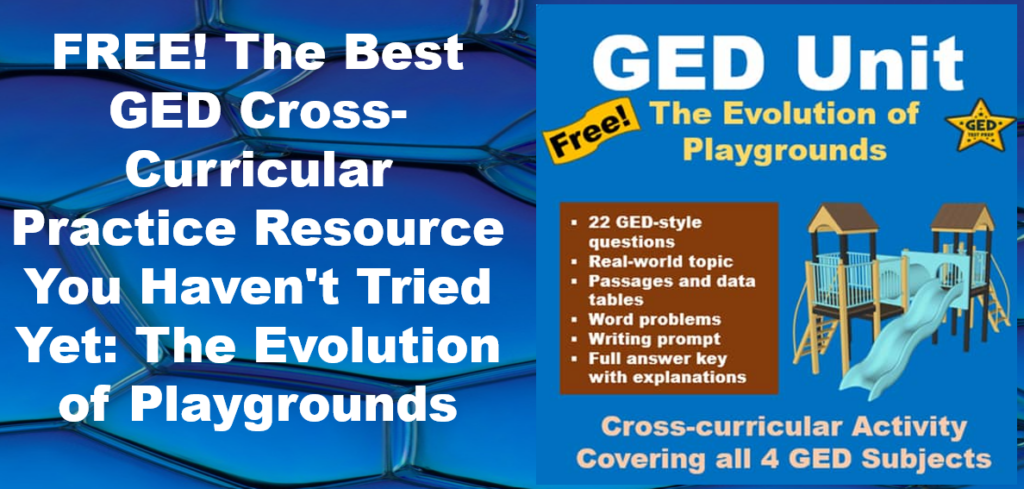
A complete, standards-aligned GED prep packet covering all four subject areas — Math, Science, RLA, and Social Studies — built around one surprisingly rich real-world topic.
Why Cross-Curricular GED Prep Actually Works
If you’ve ever sat down with a GED student who dreads test day, you’ve probably heard some version of the same thing: “It’s too much. There’s just too much to learn.” And they’re not wrong — the GED covers four distinct subject areas, and for adult learners who may have been out of school for years, the sheer scope of it can feel overwhelming.
That’s exactly why cross-curricular resources are so powerful in the adult education classroom.
Instead of teaching skills in isolation — today we do reading comprehension, tomorrow we do math, next week we do science — a cross-curricular packet anchors all four subject areas around a single, engaging topic. Students build vocabulary and schema around that topic once, and then apply it across multiple skill sets. The result? Better retention, more confident learners, and a much more efficient use of limited class time.
The Evolution of Playgrounds: A Cross-Curricular GED Preparation Resource does exactly this. It takes the surprisingly rich, debate-worthy topic of playground design and safety — something virtually every adult has direct personal experience with — and uses it to teach skills across all four GED content areas in a cohesive, connected way.
This post breaks down exactly what’s in this packet, why it works for GED students, and how you can use it in your classroom.
Who This Resource Is For
This packet is designed for:
- GED instructors teaching multi-subject prep classes or looking for a high-interest review resource
- Adult education teachers in ABE, GED, and workforce development programs
- Correctional education instructors looking for age-appropriate, engaging content that treats adult learners with dignity
- Independent GED learners who want to practice across all four subjects in one sitting
- Tutors and learning centers who need a flexible, self-contained review packet
One of the most common challenges in adult education is finding material that is simultaneously age-appropriate and accessible. Many GED prep resources feel either condescending (written for middle schoolers) or impractical (so abstract they don’t connect to real life). The playground topic threads this needle beautifully. Every adult remembers playgrounds. Many are parents or grandparents who have strong opinions about playground safety. The topic is immediately relatable, inherently interesting, and — as this packet demonstrates — academically rich.
A Quick Look Inside: What the Packet Covers
Section 1: Reasoning Through Language Arts (RLA)
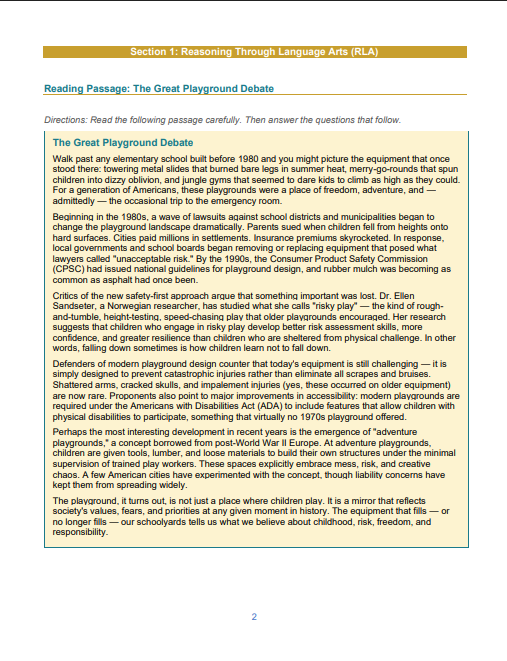
The RLA section centers on an original informational passage titled “The Great Playground Debate.” This is a well-crafted, multi-perspective argumentative text that presents:
- The history of traditional playground equipment (metal slides, merry-go-rounds, jungle gyms)
- The wave of lawsuits in the 1980s that transformed playground design nationwide
- Dr. Ellen Sandseter’s research on “risky play” and its developmental benefits
- The counterargument from modern playground safety advocates
- The ADA’s requirement for accessible playground features
- The growing “adventure playground” movement and why it hasn’t spread widely in the U.S.
The passage closes with a strong metaphorical conclusion — “The playground, it turns out, is not just a place where children play. It is a mirror that reflects society’s values, fears, and priorities at any given moment in history” — which sets up a literary device question that directly mirrors GED test content.
RLA questions in this section cover:
- Central argument identification (inferential reading)
- Identifying primary cause and effect (textual evidence)
- Literary device recognition: metaphor vs. simile vs. personification vs. hyperbole
- Passage structure and text organization
- Drawing inferences from the text
The section also includes an Extended Response writing prompt that asks students to take a position on the playground debate, cite specific evidence from the text, and organize their argument into at least three paragraphs. A detailed scoring guide and a full sample high-scoring response are included — an invaluable resource for instructors and self-directed learners alike.
The sample response models exactly what GED scorers are looking for: a clear thesis, evidence-based body paragraphs, logical transitions, and a purposeful conclusion. Seeing this written out in full is often a breakthrough moment for students who struggle to understand what a “well-developed” extended response actually looks like in practice.
Section 2: Social Studies
The Social Studies section uses a timeline format to teach source analysis and historical reasoning. The timeline traces U.S. playground policy from 1906 through the present, covering major events including:
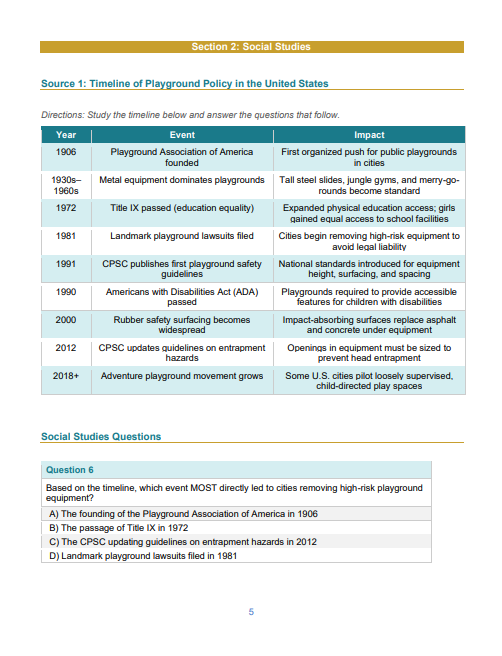
- The 1906 founding of the Playground Association of America
- The dominance of metal equipment from the 1930s through the 1960s
- The 1972 passage of Title IX and its effect on physical education access
- The 1981 landmark lawsuits that triggered the nationwide removal of “high-risk” equipment
- The 1991 CPSC playground safety guidelines
- The 1990 Americans with Disabilities Act and its impact on playground accessibility
- The 2000 widespread adoption of rubber safety surfacing
- The 2012 CPSC update on entrapment hazards
- The 2018+ growth of the adventure playground movement
Social Studies questions cover:
- Identifying cause and effect from a primary source document
- Evaluating which evidence best supports a given claim (a key GED social studies skill)
- Drawing conclusions about social values from policy decisions
- Identifying trends across time
- Using historical context (the Progressive Era) to explain a specific event
This section gives instructors a natural opening to discuss civic concepts — federal agencies, civil rights legislation, legal liability — in a context that doesn’t feel abstract or disconnected from real life. A conversation about why the ADA matters, grounded in something as concrete as a playground, can be far more meaningful than a textbook definition of disability rights.
Section 3: Science
The Science section is where this packet really distinguishes itself. The reading passage, “The Physics and Biology of Playground Injuries,” introduces genuine scientific content at an appropriate GED reading level without oversimplifying the material.
The passage covers:
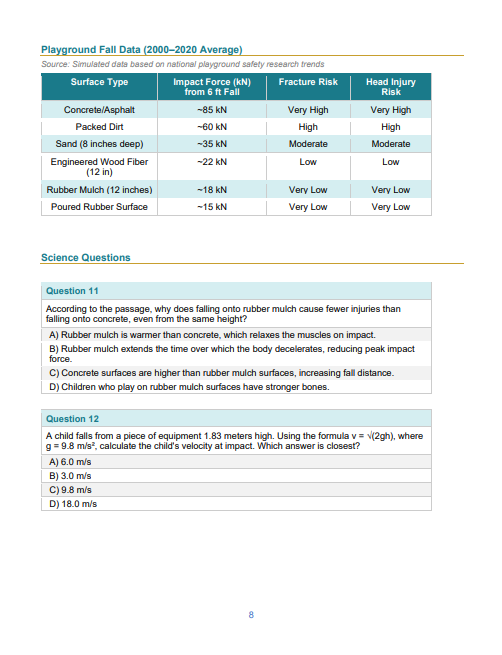
- The physics of falling: gravitational acceleration at 9.8 m/s², and the formula v = √(2gh) for calculating impact velocity
- Why surface materials matter: the principle that softer surfaces extend deceleration time, reducing peak impact force
- Children’s biology: the role of cartilage, growth plates, and their unique vulnerability to certain types of injury
- Head injuries and traumatic brain injury (TBI): why developing brains are at particular risk
The packet includes a data table showing simulated impact force data (in kilonewtons) for six different surface types — from concrete/asphalt down to poured rubber — along with associated fracture and head injury risk levels. Students are asked to interpret this data alongside the passage, which mirrors the GED Science test’s emphasis on integrating text and visual information.
Science questions cover:
- Understanding cause-and-effect in a scientific context
- Applying a formula to calculate a numeric result (v = √(2gh))
- Interpreting a data table and performing comparative analysis
- Applying scientific reasoning to explain biological phenomena
- Identifying which claims are supported by multiple sources (a cross-source synthesis skill)
The math embedded in Question 12 — where students actually plug numbers into the free-fall formula — is a fantastic preview of the kind of applied math that appears on both the GED Science and Math tests. This kind of cross-subject skill reinforcement is one of the packet’s greatest strengths.
Section 4: Mathematical Reasoning
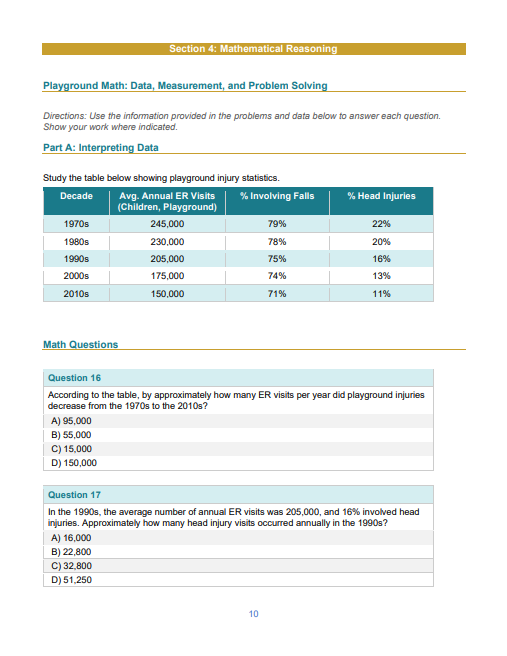
The Math section covers a solid range of GED math skills through a series of applied word problems grounded in the playground context. A data table of playground injury statistics from the 1970s through the 2010s provides the source material for the first several questions.
Math skills covered include:
- Data interpretation: Reading a multi-column table and performing calculations from it
- Percent of a number: Calculating the number of head injury visits from a total and a percentage
- Volume and cost calculation: Computing cubic footage for rubber mulch coverage and multiplying by cost per unit
- Mean/average: Finding the mean number of children served across three playground structures
- Perimeter: Calculating the perimeter of a square landing zone (with a built-in distractor — extra information that isn’t needed to solve the problem)
- Percent decrease: Distinguishing between a percentage point decrease and a percent decrease — a notoriously tricky concept that appears regularly on the GED
- Discount and bulk pricing: Applying a percent discount to a multi-unit purchase
The variety of skills in this section is well-calibrated for GED prep. The perimeter problem is deliberately designed with an extra piece of information (the height of the slide) that students must recognize as a distractor — exactly the kind of trap the GED includes to assess whether students can identify relevant from irrelevant information.
The percent decrease question (Question 21) is particularly valuable. Many students conflate “the rate dropped by 11 percentage points” with “the rate dropped by 11%.” This question forces them to distinguish the two — and the answer key explanation walks through the logic step by step.
The Answer Key: More Than Just Correct Answers
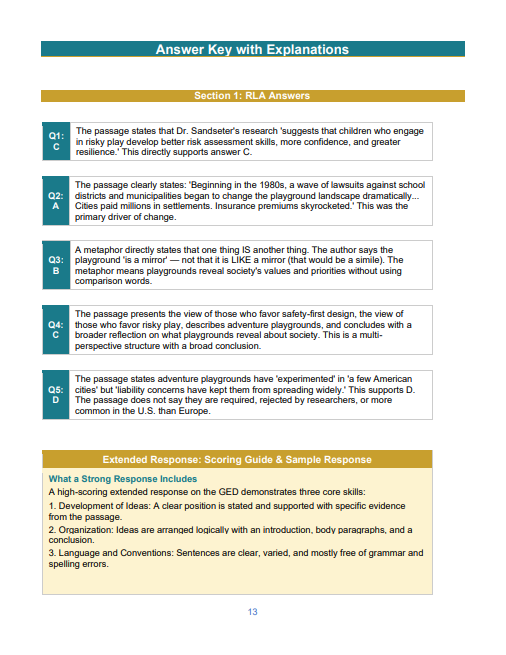
One of the most underrated features of this packet is the quality of the answer key. Rather than simply listing correct answers, every explanation tells students:
- What the correct answer is and why
- Why the wrong answers are wrong (on many questions)
- What skill or concept the question is testing
- How to approach similar problems on the real GED
For example, the answer key explanation for Question 20 (perimeter of the landing zone) explicitly tells students that the 10-foot slide height is “extra information not needed to solve this problem — a common GED test strategy.” That kind of metacognitive coaching is exactly what GED students need. It teaches them not just content, but how to take a test.
The extended response scoring guide goes even further, listing the specific criteria that GED scorers use (development of ideas, organization, language and conventions) and then modeling a complete, high-scoring response with annotations explaining why each section works.
For instructors, this makes the packet genuinely self-contained. You don’t need to prepare a separate answer key, create your own rubric, or write your own model response. Everything is there.
How to Use This Packet in Your Classroom
Option 1: Full Cross-Curricular Review Day
Assign the entire packet in a single long class session (90–120 minutes) as a comprehensive review. This works well when you want students to experience how a single topic can span multiple academic disciplines — an important conceptual shift for GED learners who tend to compartmentalize subjects.
Option 2: Targeted Subject Review
Each section is self-contained and can be used independently. If you’re focusing on science this week, pull out Section 3. If your class needs extended response practice, focus on Section 1. The packet is designed to be used flexibly.
Option 3: Differentiated Instruction
Assign the reading passage (Section 1) to the whole class, then differentiate by having lower-level students focus on the multiple-choice questions while more advanced students tackle the extended response. For science, some students may work with just the data table while others work through the formula application in Question 12.
Option 4: Test Simulation
Use the packet as a timed practice test. Assign realistic time limits for each section and have students score their own work using the answer key. Debrief as a class, focusing especially on questions students got wrong and why.
Option 5: Discussion Starter
The “Great Playground Debate” passage is rich enough to anchor a substantive class discussion. Use the two sides of the debate — safety vs. developmental risk — as the basis for a Socratic seminar. Many adult learners have strong opinions about risk, safety, parenting, and childhood, and connecting those opinions to academic reading skills is a powerful engagement strategy.
Why the Playground Topic Works So Well for Adult Learners
The topic selection here is genuinely smart. Playgrounds aren’t just for children — they’re for anyone who was once a child, anyone who has raised a child, and anyone who lives in a community with children. That’s essentially everyone in a GED classroom.
The topic also works because it carries real emotional and cultural weight without being politically divisive or personally painful. It’s a topic students can engage with academically without triggering trauma responses or political defensiveness. That matters enormously in adult education settings, especially in correctional contexts.
The “debate” framing in the RLA section is particularly effective. Adult learners respond well to material that treats them as capable of forming and defending opinions. The risky play vs. safety-first debate has genuine merit on both sides, and students who work through it come away having practiced critical thinking, not just test-taking.
Alignment to GED Content Areas
This packet addresses content across all four GED subject areas:
Reasoning Through Language Arts
- Reading informational texts for central ideas and details
- Identifying author’s purpose and text structure
- Recognizing literary devices (metaphor)
- Drawing logical inferences
- Extended response writing with evidence-based argumentation
Social Studies
- Using primary source documents (timelines, policy records)
- Analyzing cause and effect in civic and historical contexts
- Identifying trends in public policy
- Understanding the role of government in shaping society
- Historical contextualization (the Progressive Era)
Science
- Physics: kinematics and force calculations
- Biology: bone development and neurological vulnerability
- Data interpretation from tables
- Integration of text and data sources
- Scientific reasoning and claim evaluation
Mathematical Reasoning
- Multi-step word problems
- Percents: percent of a number, percent decrease
- Geometry: perimeter calculation
- Volume and cost application
- Data table interpretation and computation
- Mean/average calculation
What Makes This Packet Different from Other GED Prep Materials
There’s no shortage of GED practice materials on the market. What makes this one worth your time and your students’ time?
1. It respects adult learners. The content is intellectually substantive. The passage assumes students can engage with nuance. The questions require actual thinking, not just memorization.
2. It connects skills across subjects. The physics concept in Section 3 reinforces the math in Section 4. The historical timeline in Section 2 provides context for the debate in Section 1. Students who work through the packet in order experience a rare thing: a unified academic experience built around a single coherent topic.
3. The explanations are teaching tools. The answer key isn’t an afterthought. It teaches. Every explanation is written with the GED student (and their teacher) in mind.
4. It’s practical and flexible. No special supplies, no technology requirements, no elaborate setup. Print it and go. Or assign individual sections as needed. The design puts teachers in control.
5. It models the GED’s cross-source integration demands. The Science section in particular mirrors the GED’s habit of pairing a reading passage with a data table and asking students to use both. Many students practice reading or data interpretation in isolation — this packet forces them to do both at once.
A Note on the Extended Response Section
If there’s one part of the GED that adults tend to fear more than anything else, it’s the extended response. Thirty minutes, one prompt, a blank screen (or blank page), and the task of producing a coherent, evidence-based argument. For students who haven’t written academically in years — or who never felt confident in their writing — this can be the single biggest barrier between them and their diploma.
The extended response section in this packet addresses that fear directly. It doesn’t just give students a prompt and wish them luck. It provides:
- A clear description of what GED scorers look for
- A complete model response written at the expected level
- Specific annotations explaining why each paragraph works
- A framework students can internalize and apply to any extended response prompt
Instructors who use this section in class should consider having students read the model response out loud, discuss what makes it effective, and then attempt their own response before checking back. The contrast between “here’s what a strong response looks like” and “here’s my attempt” is one of the most effective feedback loops in writing instruction.
Get This Resource for Your Classroom
The Evolution of Playgrounds: A Cross-Curricular GED Preparation Resource is available in the Wild and Wacky Worksheets store on Teachers Pay Teachers.
Whether you’re teaching a multi-subject GED class, running a one-on-one tutoring session, or looking for a comprehensive review resource that treats your adult learners with intelligence and respect, this packet delivers.
It’s ready to print, ready to use, and built for the real GED — not a simplified version of it.