Essential Guide for Teaching Personality Types in Adult Education
If you’ve spent time in an adult education classroom, you already know something research eventually confirms. Moreover, our students aren’t here only to pass a test. They are here to figure out what comes next.
It might be a job, a career change, or a GED that opens a door long closed. Additionally, most of them are working without being asked a simple question: how their personality type helps them work best.
Not “are you smart.” Not “are you a good student.”
Specifically, how do you think, decide things, and handle a room full of people?
Or you have an hour alone with a stack of paperwork.
That’s where a personality framework comes in.
However, this isn’t a fluffy “which Hogwarts house are you” activity dressed up for adults.
Used the right way, it’s a fast, low-cost tool that helps people understand their personality type.
It could help them study, handle a job interview, or talk to a supervisor without it turning into a standoff.
Adult students are making bigger decisions than traditional students, with less support.
A 17-year-old in a traditional high school has counselors, parents, and a well-worn path ahead.
Our students often don’t have any of that.
They’re 22, or 45, or 61.
They’re deciding whether to enroll in a CDL program or a CNA program.
They’re trying to figure out why they keep butting heads with a supervisor, a pattern tied to their personality type.
Additionally, they’re wondering why studying alone feels impossible, or why group work makes them want to walk out.
These aren’t small questions, and they don’t have small consequences. A GED is often the first step in a much bigger transition — into a trade program, a new job, a reentry plan, a completely different chapter of life. When students understand how they operate, they make those transitions with a lot less trial and error.
This is really a self-advocacy skill.
A student who says, ‘I do better with hands-on instructions’ can ask for what they need, including quiet time.
Additionally, this applies in your classroom and in the workplace after they leave it.
What a personality type assessment actually measures
The framework is built on four simple questions:
- Where do you get your energy? (Extraversion vs. Introversion)
- How do you take in information? (Sensing vs. Intuition)
- How do you make decisions? (Thinking vs. Feeling)
- How do you approach structure and time? (Judging vs. Perceiving)
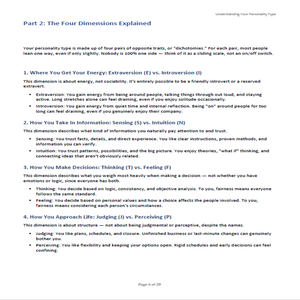
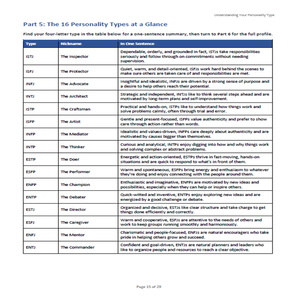
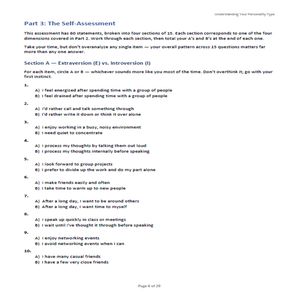
That’s it. Four questions, sixteen possible combinations, and a surprising amount of insight for something that takes less than an hour to work through.
It’s not a clinical or diagnostic tool, and it’s not meant to put anyone in a box. Additionally, what it is good for is giving students vocabulary for patterns they’ve probably noticed about themselves. For years, they’ve noticed patterns about themselves but never had a name for. This quote becomes: “I’m an introvert, and I do my best thinking alone before I bring it to the group.” The same fact now shows a completely different relationship to it.
Where This Pays Off in an Adult Ed Classroom
Study habits reveal your personality type, no longer a mystery
I can’t tell you how often a student says they ‘just can’t study.’ They have only followed someone else’s method. However, a Sensing-type student trying to learn from abstract theory alone is going to struggle. Similarly, an Intuitive student stuck doing nothing but repetitive drill work also struggles. Once students understand their information-processing style, ‘I can’t study’ often becomes ‘I just needed a different method’. Understanding your personality type guides you to methods that fit you.
Additionally, it gives you a shared language for classroom friction.
You already know this: put a fast-moving, decisive student next to a slow-and-steady, detail-oriented one.
Moreover, when students have language for these differences, you’re more Judging, I’m more Perceiving. Conflict turns into curiosity instead of personal offense.
That alone can defuse a lot of tension in group work.
3. It’s a career and workforce readiness tool, not just a personal one, i.e., a personality type.
This is the piece that matters most for our population. A student who knows they’re a Thinking-Sensing type might be a great fit for the electrical program. Additionally, a Feeling-Intuitive student who assumed they had no direction might realize counseling or healthcare aligns with their personality type.
4. It prepares students for workplace conversations about personality type that nobody teaches.
A student who understands communication styles can handle a blunt supervisor.
They can communicate more directly with a supervisor who needs specifics.
Moreover, recognizing your personality type helps you adapt to expectations.
These are the soft skills that keep people employed.
They’re rarely taught explicitly anywhere else in an adult ed curriculum.
“I Don’t Have Time to Build This From Scratch” — I Know. That’s Why I Built It.
If you’re nodding along, this sounds great.
I hear you if you lack three prep periods to build an assessment and to write profiles for sixteen types.
I designed a solution that ties it to real-world application.
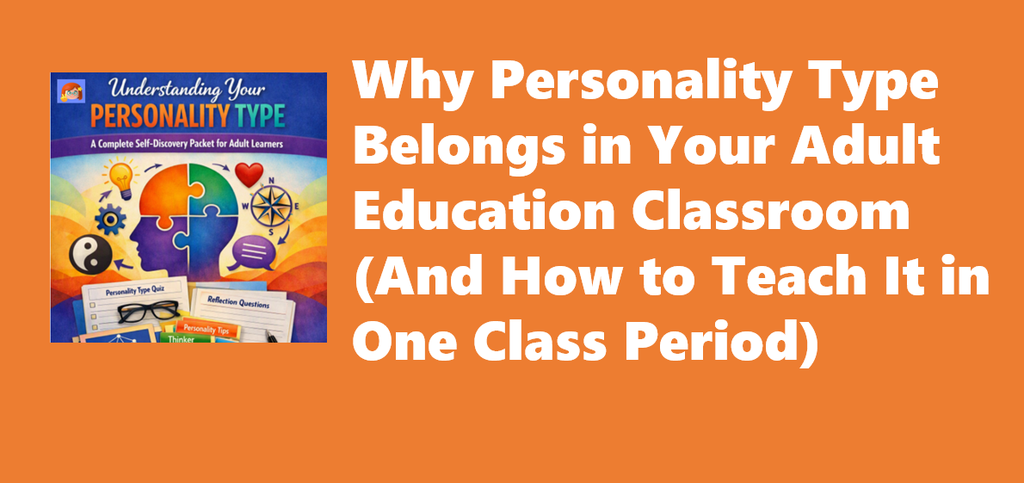
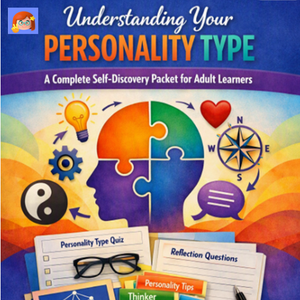
Thus, that is why I put together Understanding Your Personality Type: A Discovery Packet for Adult Learners.
It is a print-and-go, 29-page resource built for adult education, workforce readiness, and reentry classrooms.
It includes personality type.
- A 60-question self-assessment — hand-scored, no devices, no logins, no tech headaches
- Full profiles for all 16 personality types, written in plain language with real strengths, growth areas, and career suggestions relevant to our students (skilled trades, healthcare, workforce programs — not just “consultant” and “CEO”)
- Real-life application guides covering study strategies, workplace communication, and stress management for every trait
- A communication styles chart your students can actually use with coworkers and supervisors
- A career exploration chart connecting personality patterns to career clusters
- Reflection worksheets and a 30-day action plan so the insight turns into an actual next step, not just an interesting afternoon
I built this the same way I build everything for my classroom. Assuming the user has fifteen other tasks that day, they need something that works the first time.
How I’d Use This in a Single Class Period
Additionally, if you want to try this tomorrow, here’s the fastest path for your personality type.
- Start with a two-minute framing conversation. Ask students: “Have you ever noticed you and a coworker or classmate just see things totally differently, and you couldn’t figure out why?” Let a few answer. This is the hook.
- Hand out the assessment. Give students 20–25 minutes to work through all 60 questions at their own pace.
- Score together. Walk through the scoring instructions as a class so nobody gets stuck.
- Let students read their own type profile silently, then open it up: “Does this feel accurate? What surprised you?”
- Close with one worksheet. Even just the general reflection page turns this from “a fun activity” into something students actually carry with them.
That’s a full, meaningful lesson — no extra prep, no grading, and something students genuinely remember weeks later.
Additionally, I’ve had students mention their personality type months after a lesson like this.
Indeed, it sticks more than a worksheet on comma rules.
The Bigger Point about personality type
Adult learners have often spent years being told what they’re bad at.
They are told they’re bad at school, tests, and ‘adulting’ in life.
Moreover, a tool like this flips that script.
It’s not about weaknesses.
It’s about giving someone a mirror.
It reflects how they work, so they can stop fighting their own wiring.
This helps them understand their personality type and start using it.
That’s a pretty big return for one class period, reflecting this personality type’s rapid progress.
Additionally, consider using this resource to better understand your trainees’ personality type.
Want the whole packet, ready to print?
Understanding your personality type: A Discovery Packet for Learners is available now in my Wild and Wacky Worksheets TPT store.
Additionally, if you try it in your classroom, I would love to hear how it goes; please comment.