Why Mastering Percents and Proportions Is Critical for Passing the GED Math Test
If you are preparing for the GED Math exam, there is one truth you need to understand:
Percents and proportions are everywhere on the test.
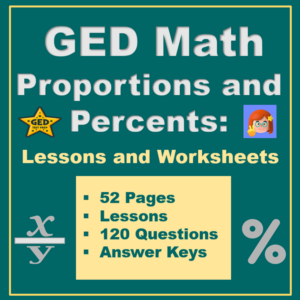
The GED Math Proportions and Percents: Lessons and Worksheets packet percents and proportions was specifically designed to target two of the most heavily tested GED math topics. With 52 pages of lessons, guided examples, worksheets, and answer explanations, this resource gives students structured, step-by-step preparation in exactly the areas where many GED test-takers struggle.
Let’s break down why this resource is so important for GED success.
1. Percents and Proportions Make Up a Large Portion of the GED Math Exam
Proportions and percents account for a significant portion of GED math questions percents and proportions.
On the GED exam, you will see these skills tested in:
- Sales tax and discounts
- Percent increase and decrease
- Unit rates and better buys
- Map scales
- Simple interest
- Tips and markups
- Commission and income problems
- Proportional reasoning
- Multi-step real-world word problems
If you are weak in these areas, your GED math score will suffer.
This packet directly targets those high-frequency skills so students are not surprised on test day.
2. It Teaches the Why — Not Just the Answers
Many GED students struggle because they memorize steps without understanding why they work.
This resource begins with foundational understanding:
- What is a ratio? (Unit 1)
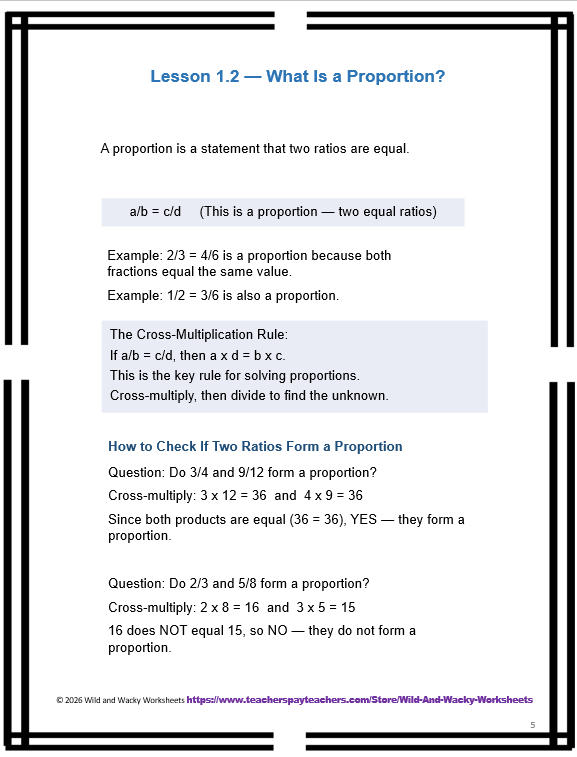
- What is a proportion? (Unit 1.2)
- How does cross-multiplication work?
- What does percent actually mean? (Unit 3)
Instead of jumping straight into worksheets, the packet builds conceptual understanding first. For example:
- Page 5 clearly explains the cross-multiplication rule.
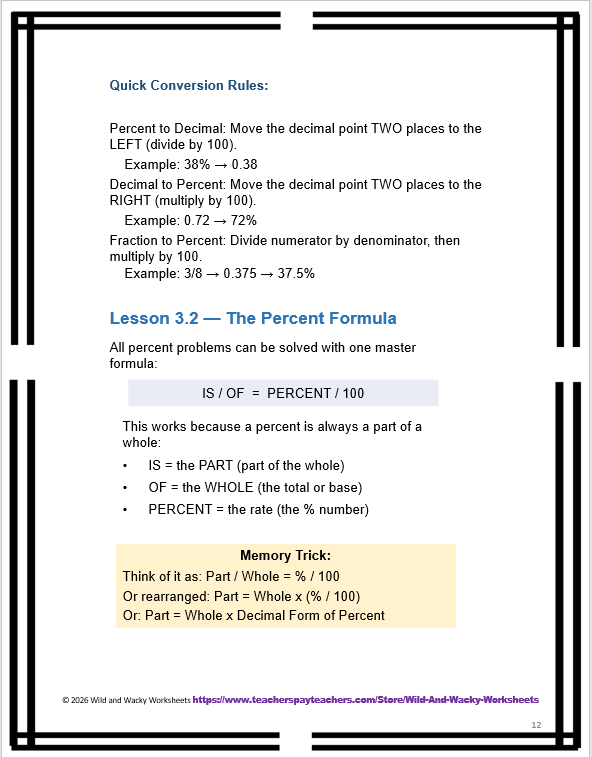
- Page 12 introduces the master percent formula:
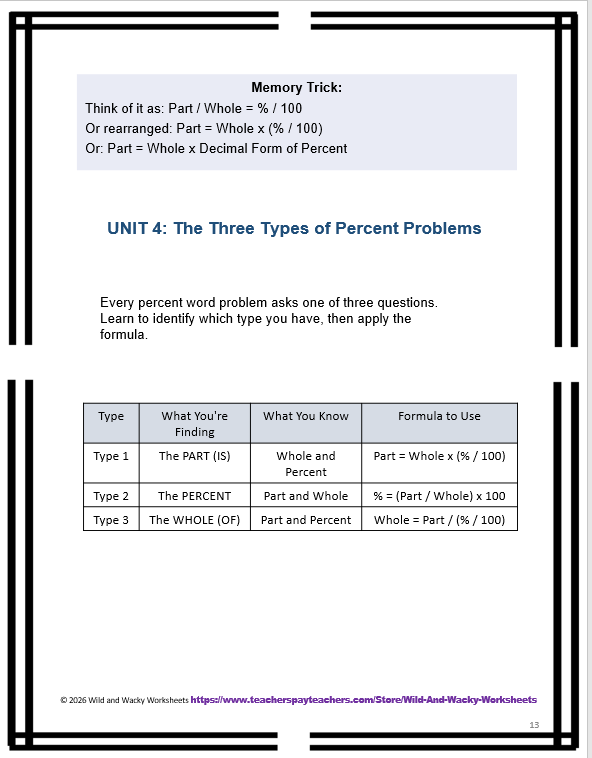
IS / OF = PERCENT / 100 - Page 13 breaks percent problems into three types so students can quickly identify what they’re solving.
This structure reduces confusion and builds confidence.
3. It Breaks Percent Problems Into 3 Clear Types
One of the most powerful features of this resource is Unit 4 (page 13), which categorizes all percent word problems into three types percents and proportions:
- Finding the Part
- Finding the Percent
- Finding the Whole
Many students panic because they don’t know which formula to use.
This packet removes that uncertainty.
By learning how to identify the problem type first, students:
- Work faster
- Make fewer mistakes
- Feel more confident
- Improve multiple-choice accuracy
That skill alone can raise a GED math score significantly.
4. It Focuses on Real-World GED Applications
The GED is not just about abstract math — it focuses heavily on practical, real-life applications.
This resource includes entire units dedicated to:
- Percent increase and decrease (Unit 5)
- Sales tax and tips (Lesson 5.3)
- Simple interest (Unit 6)
- Exchange rates
- Mixture problems
- Unit cost comparisons
- Better buy problems
These are exactly the types of applied math problems students encounter on the GED exam.
For example:
- Calculating commission
- Finding take-home pay after taxes
- Determining sale prices after multiple discounts
- Calculating markup and percent change
- Solving scale map problems
These real-world skills are critical not only for the test — but for everyday life.
5. It Provides Extensive Practice (120 Questions!)
Practice is what turns understanding into test-day confidence.
This packet includes:
- 10 full worksheets
- Mixed review
- GED-style multiple choice questions (Problems 101–120)
- A complete answer key with explanations
That means students aren’t just solving problems — they are learning from their mistakes.
The answer key (pages 47–51) does more than list answers. It explains:
- Why cross-multiplication works
- How percent formulas are applied
- How to check answers
- Where students may go wrong
This level of feedback is essential for GED students who are studying independently.
6. It Mimics the GED Test Format
The bonus section includes GED-style multiple-choice practice questions (pages 43–46) percents and proportions.
This is extremely important because:
- The GED is a timed test.
- It includes multiple-choice answers.
- Students must eliminate distractors.
- Word problems are often multi-step.
The packet even includes test-taking tips such as:
- Eliminate obviously wrong answers first.
- Write out your work.
- Check your solution by plugging it back in.
This prepares students for the format — not just the content.
7. It Builds Confidence Through Structure
GED math anxiety is real.
Many adult learners:
- Have been out of school for years.
- Struggle with math confidence.
- Fear word problems.
- Feel overwhelmed by formulas.
This packet uses:
- Clear 4-step proportion methods
- Formula boxes
- Memory tricks
- Step-by-step worked examples
- Gradual skill progression
That structure reduces overwhelm and builds mastery.
When students feel confident with percents and proportions, they walk into the GED exam with a major advantage.
8. These Skills Impact Other GED Math Topics
Percents and proportions are not isolated skills.
They connect to:
- Algebra
- Geometry
- Data analysis
- Financial literacy
- Word problem solving
- Ratios in graph interpretation
Improving percent and proportion skills strengthens overall mathematical reasoning — which impacts the entire GED math test.
Final Thoughts: Why This Resource Matters
If you want to pass the GED Math exam, you must be fluent in:
- Ratios
- Proportions
- Unit rates
- Percents
- Percent change
- Sales tax and tips
- Simple interest
- Multi-step real-world applications
The GED Math Proportions and Percents: Lessons and Worksheets packet percents and proportions delivers all of that in one structured, comprehensive resource.
With:
- 52 pages
- 120 practice questions
- Step-by-step lessons
- Real GED-style problems
- Detailed answer explanations
It provides exactly what GED students need: clarity, repetition, application, and confidence.
If you are serious about increasing your GED math score, mastering percents and proportions is not optional — it is essential.
And this resource was designed specifically to help you do just that.