Make GED Science Review Sweet with Valentine’s Day Learning
Let’s be honest—GED science preparation isn’t usually associated with hearts, chocolates, and romance. But what if it could be?
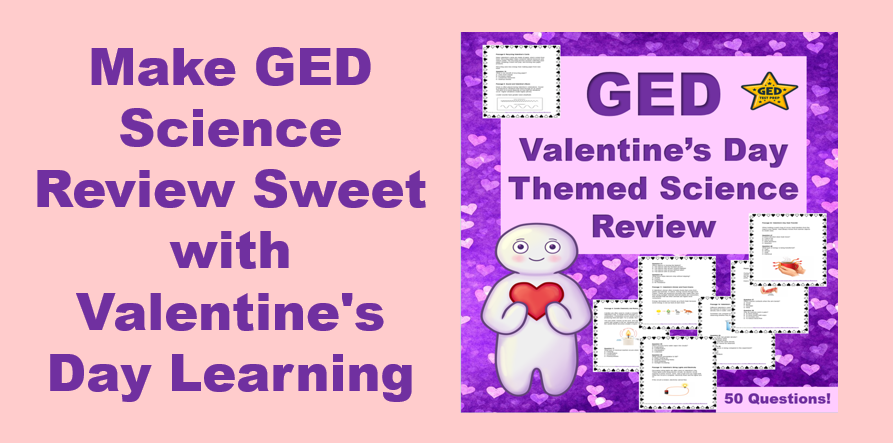
February is just around the corner, and while your students are thinking about Valentine’s Day plans, you have an opportunity to meet them where they are. That’s exactly why I created “Valentine’s Day GED Science Review: Love Is in the Data”—a comprehensive 50-question science review that proves test prep doesn’t have to be boring.
Why Themed Review Materials Work
After years of working with GED students, I’ve learned something important: engagement matters just as much as content quality. Adult learners juggle jobs, families, and countless responsibilities. When they walk into your classroom, they’re often tired, stressed, and wondering if they can really do this.
That’s where creative review materials come in.
When students see familiar, relatable contexts—like Valentine’s Day celebrations—they relax. The material feels less intimidating. They think, “Oh, this is about chocolate and heart rates? I know about those things!” And suddenly, photosynthesis or circuit diagrams don’t seem quite so scary.
What Makes This Resource Different
Real GED Science Content with a Festive Twist
Don’t let the Valentine’s theme fool you—this is serious test preparation. All 50 questions align with GED science standards and mirror the types of questions students will encounter on test day:
- Life Science: From heart anatomy to genetics, photosynthesis to ecosystems
- Physical Science: Motion, energy transfer, electricity, and sound waves
- Chemistry: Combustion reactions, states of matter, density, and gas laws
- Earth Science: Weather patterns, the water cycle, and climate concepts
- Scientific Practices: Data analysis, experimental design, and evidence-based reasoning
Data Analysis Skills Built Right In
One of the biggest challenges GED students face is interpreting graphs, charts, and diagrams. This resource provides multiple opportunities to practice these critical skills through:
- Heart rate comparison graphs
- Temperature data charts
- Punnett squares for genetics
- Food chain diagrams
- Population trend graphs
- Circuit diagrams and wave illustrations
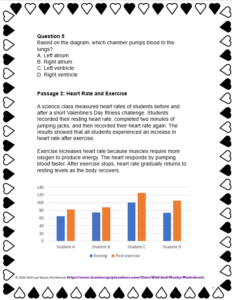
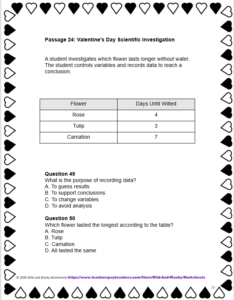
Each visual element requires students to not just read data, but to analyze, compare, and draw evidence-based conclusions—exactly what they’ll need to do on test day.
Relatable Real-World Connections
The Valentine’s Day theme isn’t just decorative—it creates meaningful connections between scientific concepts and students’ lives:
- Heart rate and exercise connects to seeing someone special or dancing at a Valentine’s celebration
- Chocolate and energy explores the biology behind that sugar rush from Valentine’s candy
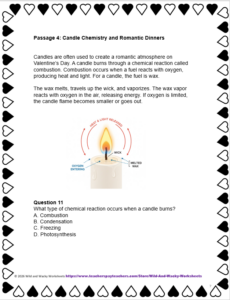
- Candle chemistry explains the combustion happening during romantic dinners
- Rose photosynthesis brings plant biology to life through a familiar Valentine’s gift
- Helium balloons and gas laws makes abstract chemistry concrete and observable
When students see science in contexts they understand, those concepts stick.
How to Use This Resource in Your GED Classroom
As a Comprehensive Review Packet
Use all 50 questions as a thorough science review leading up to the GED exam. Students can work through sections independently, and you can use the detailed answer key for whole-class review discussions.
For Targeted Skill Practice
Break the resource into smaller chunks focused on specific content areas. Assign passages 1-5 for life science review, passages 11-13 for physical science, and so on. This allows you to customize review based on your students’ needs.
As a Formative Assessment
Use the packet to identify knowledge gaps before test day. The comprehensive nature of the questions helps you pinpoint exactly where students need additional support.
For Station Rotation Activities
Print different passages and set up learning stations around your classroom. Students rotate through stations, tackling different science domains while staying engaged through variety.
As Emergency Sub Plans
Let’s face it—sometimes you need quality materials ready to go at a moment’s notice. This print-and-go resource keeps students productively engaged with meaningful learning, even when you’re unexpectedly absent.
The Psychology of Seasonal Learning
There’s actual educational psychology behind why themed materials work so well:
1. Reduced Anxiety: Familiar, festive contexts lower students’ affective filters, making them more receptive to learning challenging content.
2. Increased Motivation: Seasonal materials feel timely and relevant, giving students a reason to engage right now rather than procrastinating.
3. Enhanced Memory: When we attach new information to existing schema (like Valentine’s Day knowledge), we create stronger neural pathways and better retention.
4. Positive Associations: Pairing difficult content with pleasant themes helps students build more positive associations with science, reducing the “I’m just not a science person” mindset.
Real Talk: Addressing the “But Is It Rigorous Enough?” Concern
I hear this question sometimes: “Won’t a Valentine’s Day theme make the material seem less serious or academic?”
Here’s my response: The theme enhances accessibility without sacrificing rigor. Every single question in this resource:
- Aligns with GED science standards
- Requires scientific reasoning and critical thinking
- Mirrors actual test question formats
- Demands evidence-based answers
- Builds essential data analysis skills
The Valentine’s Day context is simply the delivery mechanism for robust scientific content. Think of it like this: if you needed to take medicine, would you rather swallow a bitter pill or one with a pleasant coating? The medicine is the same—one just goes down easier.
Beyond February: The Case for Year-Round Themed Materials
While this resource is perfect for February, the broader lesson here is about meeting students where they are throughout the year. When you connect content to students’ current experiences—whether that’s holidays, current events, or seasonal activities—you create hooks for learning that stick.
Adult learners especially appreciate when educators acknowledge their full humanity. Yes, they’re here to pass the GED. But they’re also people with lives, interests, and yes, Valentine’s Day plans. When we honor both realities, learning becomes more meaningful.
Final Thoughts: Love and Learning
At its core, effective GED instruction is about more than just content delivery. It’s about believing in your students’ potential, creating pathways to success, and making the journey as engaging as possible.
This Valentine’s Day science review embodies that philosophy. It says to students: “I see you. I know you have a life outside this classroom. And I believe you can master this content while enjoying the process.”
Because ultimately, helping students succeed isn’t just about rigorous content—it’s about creating conditions where learning can thrive. Sometimes that means wrapping heart anatomy in a heart-shaped package.
Ready to add some love to your GED science prep? Grab this resource from my TPT store and watch your students engage with science in a whole new way this February.